Twitter

Instagram View Richard Barrett-Jolley's profile on LinkedIn
Showing posts with label Doctor. Show all posts

Sunday, 17 November 2013

King Richard III's spine and the "ion channels", "TRPV4".

Richard III skeleton
Funky ion channels in King Richard III's skeleton
I am sure that most sensible scientists, medics and vets would appreciate that ion channels are *the* most important proteins in the body? …OK all proteins are important, but none are as exciting as ion channels, which sit in the membrane of every cell and can control their functions.  …but I think it is about time to bring the word “ion channel” to the attention of archaeologists and historians through the medium of… Richard III’s skeleton.
The official line from University of Leicester (if there can be an official line) is that Ricky 3 had an idiopathic adolescent onset scoliosis.  Now the “scoliosis” bit just means “bent spine”, the “adolescent onset” bit is obvious and “idiopathic” is a posh way of saying “unknown cause”.
Therefore he had a bent spine since adolescence of unknown cause.  He also apparently had osteoarthritis.  It seems likely that a funky ion channel was at fault.  I have in mind, a particular ion channels with a gene name “TRPV4”.  In lay terms, it allows calcium to enter cells in response to movement.  Now what evidence do I have… .  eeerm…. none! That’s the great thing about blogs BUT just check-out the similarity of spine curvature with the bones of King Richard III and this well-studied literature example of a TRPV4 “channelopathy” below.

Parastremmatic dysplasia patient, with an ion channel disease

Not proof, I agree… but perhaps the many fans of Richard III should now start wearing tee-shirts with a TRPV4 channel on them… I present this suggestion below.  Have fun!!! 


Tuesday, 24 September 2013

Excuse me, but the flu is a virus

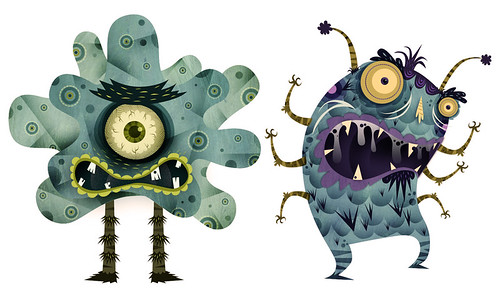
Viruses, under creative Commons licence by http://www.flickr.com/photos/acerriteno


This is a VERY short blog:  I am just amazed how many people seem to not know that a cold and the flu are all viral conditions!  EVEN SCIENTISTS! So just to clarify.  There are at least (hedging my bets) three types of infection you can get: (1) Bacterial, (2) viral and (3) parasitic.   
A "cold" is a virus.
The "flu" is a virus.
"A virus" is a virus (people often say, "I don't have a cold/the flu I have a virus"!!).

Typically, but not exclusively food poisoning will be bacterial.  (And parasites  include tapeworms and fleas.)

The distinction between a virus and bacteria is pretty crucial: Antibiotics are anti-bacterial, but have no effect on viruses. Sometimes, a bad cold, with all the sneezing and wheezing and lying around indoors can leave with you with a secondary bacterial infection, but wasn't the primary cause!   In terms of how viruses and bacteria are different... well just log on to Wikipedia!

Tuesday, 20 August 2013

Is Running Good For Your Health?

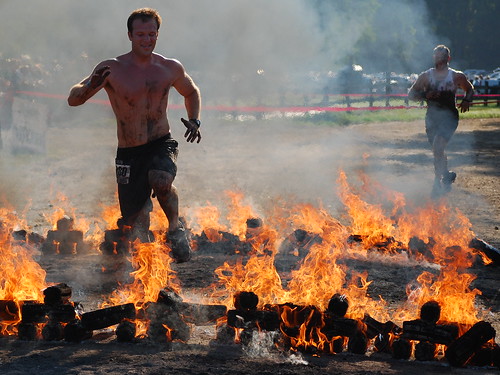
Warrior Dash Michigan

Here is the update on this blog:  
For a proper academic review of this subject see  Hunter and Eckstein 2009.
Exercise and osteoarthritis, two recent reports have been published with apparently conflicting conclusions:The medically orientated Nature Reviews in Rheumatology suggests there is (as I suggested in the previous blog optimal joint usage for healthy cartilage), and a sports medicine journal article from Dr Williams suggests that long distance running decreases risk of osteoarthritis.  
Naturally, from the Twittersphere, those people who love running feel their pursuit has been justified.  those people who commercial promote exercise will use it as propaganda.  I find it sad that on this issue, just like so many, people pick the evidence that suits their believes rather than balancing evidence.
Now lets start with a reminder.  Osteoarthritis is a condition of painful joints, which involves the whole joint, but one of its hall marks is the loss of cartilage.  Cartilage lines the hip and knee joints.  The cells that make it (chondrocytes) actually sit within the the cartilage of the joint.  They respond to the loads placed upon the joint by producing cartilage... within reason.  If you don't use a knee and hip joint at all, you would expect the muscles to waste away, the bones to become thin and brittle, and the cartilage become thin also.  I think we can probably all agree on this.  However, cartilage is a living tissue.  It is not shoe leather.  Part of the confusion is caused because cartilage has no blood vessels so it does not bleed, and it has no nerve fibers running out of it so you don't feel pain from the cartilage itself.  But it still needs to be loved!  We know for absolute certainty that excessive weight (high BMI) promotes you getting osteoarthritis, even the Dr William's paper shows this.
There is clearly debate as to how much usage is ideal.  The sporty paper could be used to support the argument that "it's the more the merrier", but there are huge confounding variables.  The author did what he could, but it is difficult!!! The analysis was not able to exclude two possibilities (1) That slimmer people (with lower BMI) may run more and (2) That people could start to run less when they get painful joints. If you believe that either (1) or (2) could be true they presumably you will come to the conclusion that this new paper does not really answer the key question of how much usage is ideal.
So the other paper, the Nature review?  Well it is just a few line summary of a very thorough paper in the "Osteoarthritis and Cartilage" journal.  But This is what is reported.  The LEAST active elderly people loose cartilage, but so do the MOST active!!!  Activity is assessed with a PASE survey, and yes age and BMI is taken into account.  Also, the study tracks people and so ceasing activity due to joint pain is less of a factor.  Now bare in mind this is activity assessed by PASE not running marathons!  PASE asks a number of activity questions, see Table 1. They then considered the top 15% and bottom 15% activity rates and compared against the middling people.
...BUT and here is the elephant in the room.  The health crises we have at the moment is due to obesity and lack of exercise of people, not over exercise, so whilst I would suggest that the jury is out on how much exercise is good for your joints.... for the rest of you LOTS of exercise is clearly a great thing.  ...and for me too, but I am lazy :-/

 So the conclusion:  Everything in moderation? 


Table 1: PASE Activities, Performances and Weight Scores
PASE stands for: Physical Activity Scale for the Elderly
ActivityAnswer  points
Walking and bicyclingHour/day     20
Light SRAHour/day     21
Moderate SRAHour/day     23
Heavy SRAHour/day     23
Muscle strength/enduranceHour/day     30
Paid/unpaid workYes/no     21
Light houseworkYes/no     25
Heavy houseworkYes/no     25
Home repairsYes/no     30
Lawn workYes/no     36
GardeningYes/no     20
Caring for othersYes/no     35


Exercise and Obesity

Now this one is more me!
Now I have to say I think the BBC "People men made us thin" series has been great, and in many ways music to my ears.  
The dogma are:
(1) Eating too much makes you fat.
(2) Exercise makes you thin.
(3) Genes

Do diets make you thin?
(1) They have gone some way to debunk this in the program.  Of course they have taken an extreme attitude.  If you don't eat, you will loose weight, but the psychology of dieting is more complex.  The study designs are difficult too.  So they studies showing diets don't work will usually say "here's a dieter 2 years later and they have put on 10lbs/5Kg, but here is a non-dieter and this person put on zero weight: ergo, dieting doesn't work".
There is a fundamental flaw in this argument though.  The people who diet typically have weight control issues and were always going to put on more weight than people who have never had a problem and never diet!!
So my bottom line would be that dieting is in no way all that it is cracked up to be, but if you are over-weight it is better to try and reduce your calorie intake than to just give up!!

(2) Does exercise make you thin

Again the program takes an extremist view of this issue.  I it is true that exercise is a really slow and relatively ineffective way of loosing weight  ...but it depends on the exercise, and whether it was the only lifestyle change you made.  Really this is a life-style thing.  To simply drive to the gym 3 times a week and burn off a few hundred calories is not going to make a significant contribution to a serious weight problem.  Those few hundred calories could easily be swallowed up just by one post exercise trip to Starbucks.  If you control calories and do more exercise, the exercise will prolong your life and keep you healthier, but really its the calorie-control bit that will knock off the pounds. Turn down that free chocolate bar at the checkout and you have just saved the equivalent of about a two mile run!  

(3) Genes
Your genes profoundly affect your weight.  This is mostly by changing the appetite control systems in your body.  Potentially there are many drugs which could change this, but it's not a great idea just yet, because these drugs tend to do too much other stuff.  ..i.e., "side effects".

All this lot is just the same for your pets too.  It's really important to give a dog a great walk or two every day... but weighing their dinners are the secret of weight control!!


Friday, 28 June 2013

"On no we are not changing the nuclear DNA"... just the mitochondrial.

DNA

On BBC radio news today we were treated to the exciting news that mitochondrial DNA transplants were going to be legal in the UK.  This would, if successfully achieved cure inherited mitochondrial metabolic diseases at a swoop.  
BUT
This horrible pill (?) had to be sweetened with all those statement that this would not be changing "who we are" because it would not touch our DNA.  
Well, lots of things change who we are.  Getting cancer and dying changes who are you, getting cancer and surviving also changes who you are.  It changes who your family is too. All sorts of things change who you are.  All sorts of things change the DNA.
For most diseases we really don't know enough about how the genes go wrong (but frequently we know that they do).  Even if we do... correcting that DNA is coming, but will be tricky. 
But should we change the nuclear DNA if we could??
Hell Yes!


Thursday, 27 June 2013

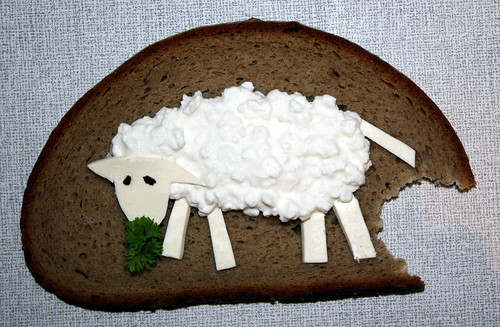
The Taste of Cheese: ... visual illusions, acupuncture and medical research!!?

Have a snack! - Was für ein Käse! :-))))))))))

The BBC were running a story all yesterday about how cheese and yoghurt taste different when eaten in different ways, like from a metal versus plastic spoon?  Did you hear it?  http://bit.ly/CheeseSense Their science editors made a mistake, because they thought it was a science is silly story.  That's is pretty much mostly what the BBC science editors like.
So why is it not silly?  Because it is a simple example of a phenomenon so hugely important that it hampers diagnoses, makes creation of new medicines difficult and fuels "woo" science and medicine.  People believe they can trust their own senses, but they simply cannot.
So lets have a visual example; this page shows a number of small videos where it is very difficult to spot obvious differences between the two images: http://bit.ly/VisualIllusions.
So as our resident experimental psychologists and neuroscientists will tell you: "you cannot trust your eyes".  
Does this relate to cheese taste?  YES.  You can't trust your eyes, and you can't trust your tongue either. The cheese obviously tastes the same (in that it is chemically identical), but you think it tastes different because of the context.  We humans are easily confused.  An aside: I guess this proves the Cher song "it's in his kiss" to be totally wrong.
Yuk, may be I shouldn't have gone there.
OK now medicine, "woo medicine" in particular.  Pain is just the same.  The owner of any particular pain is really bad at knowing the intensity of their own pain.  It is a fundamental problem.  Now there are several things going on here:
(1) It is difficult to describe or quantify pain.  Scoring, as you do to your clinician on their 1-10 scale is difficult.  We all know this, but it is different to the topic of this blog.
(2) There are definite built in body processes which dampen down pain in the same way as strong pain killers such as morphine.  These tend to be based around chemicals called "endorphins".  ...they can be activated, by stress and all sorts of things that are not fully understood.  Furthermore, the awful truth about "chronic pain" (sometimes people have long term pain without clear physical cause) is that there seem to be "un-endorphin" mechanisms we know little about (we are tying believe me!!).  This is still different though.
(3) Even excluding (1) and (2) we can't judge our own pain!  so have you had an aspirin for  headache and someone ask you if it's better? you reply something stupid like "I think so"?  Well I do!!!  ...but is not just me.  I was in great pain myself once and given morphine on a drip.  I remember saying to my nurse... "I think that seems to be working".  Obviously  3o mins later it was blindingly obvious the pain was relieved, but EXACTLY when it went off was always a bit vague to me.  So here we now have the nub of the problem... if you give someone a painkiller that is mildly effective it is very difficult for people to really know whether it has "worked" or not.  Put pressure on them, by clearly investing a lot of time and effort in trying to help them and they will say "yes its a little better" even if they really don't know.  Its human nature.  So there are ways we get around this.  We use placebos.  Just give them nothing disguised as something and see if they can tell the difference?  Frequently people "say" they feel better after they actually had nothing.  This is sometimes called the "placebo" effect and it is a scientificy way to say they said they thought they were better, but they were mistaken. It's a sensory illusion! People including scientists and clinicians frequently try to investigate a so called placebo effect, but this is nonsense.  The phenomenon is simply that there is a tendency for people to believe a pain has improved when really it hasn't. Now this is the same as the cheese*!! 
 You simply cannot trust your own senses.  So if you have a new pill you wish to test, you compare it to a placebo. If it doesn't beat the placebo you through it away. "Simples!"
...but how can you set up a placebo for acupuncture?  or gels you smear on your need to help osteoarthritis  ....or faith healers etc?  You just can't.  ...and therefore if you are trying to look for smallish improvements in peoples health and sense of well-being there is no point asking the person concerned.  Just like the cheese and the visual illusions, people are too easily confused by the context.
You cannot trust your own senses (or anyone else's).

*There is also the "pressure" aspect, ever asked directions and someone replies in a funny accent?... you will ask them to repeat it once, maybe twice, but embarrassment would prevent you from asking for 100 repeats even if you still didn't get it.  Students do it all the time.  Their mouths say "yes I understand" their eyes say "I have no idea what you are talking about".  The difference here is obviously people know they don't know, but are embarrassed to say...

Monday, 11 March 2013

Antibiotic Resistance