Twitter

Instagram View Richard Barrett-Jolley's profile on LinkedIn
Showing posts with label NHS. Show all posts

Friday, 30 August 2013

Magical Sunburn Medicines courtesy of TRPV4

28th August 2013
There was a lot of recent coverage of a paper claiming that a particular protein called "TRPV4" causes the pain of sunburn. It has been floated that this could allow us to magic up some really great sunburn relief creams and hugely increasing Q.O.L ... Quality Of Life!!
What I was hoping to do in the blog is discuss (1) why this is not such a good thing! .... (2) why I say they "claim" rather than "show", (3) what the TRPV4 protein is, and finally da da da da daaaaaaa (4) Exerimental treatments.
Why is this new discovery a bad thing?
OK chronic pain... I.e., pain which goes on for weeks, months and years is a terrible thing, and we think of this as a disease in itself. Acute pain is rather different; in some cases it is awful, but frequently it is a really effective warning that something is awry and needs to be sorted. People who lack pain sensing ability have a dreadful time, they injure themselves left right and centre and just don't know until serious harm has been done. There are animals which lack pain sensing for particular types of pain when it suits their lifestyles, but for the rest of us it's a protective mechanism to stop us injuring ourselves. So in this case, not only does the sun age your skin, but it really does, unambiguously give you cancer. The more you can tolerate being burnt, presumably the more you will allow yourself to be burnt and the more likely you are to get cancer.
DOCTOR DOCTOR, I KEEP TRYING TO GIVE MYSELF SKIN CANCER, BUT SUNBURN KEEPS DRIVING ME IN DOORS... WHAT CAN I DO ABOUT IT?
As for pain relief; in theory morphine like drugs and local anaesthetics would already stop the pain if that was all you wished to do. Morphine is considered too dangerous, and local anaesthetics, basically inappropriate. Obviously you should speak to your pharmacist of GP about treatment, but generally they'll say moisturising creams will feel nice and some ibuprofen-like drugs or paracetamol (acetaminophen) may help... a bit.

Why did I say "claim", rather than "show"?
I really hate "scientists have shown" on the news. What they should say is Dr Fred blogs and colleagues have shown... Or possibly "a new research a paper shows". Frequently, these days the truth would be "a University Public Relations press release says"..... Anyway in this case it was a research paper that the information was published. The Journal is called the Proceedings if the National Academy of Sciences (PNAS).
Well it is no suprise that TRPV4 would be involved, it is found all over the body and important for all sorts of things, but there is always scope for skepticism with this type of report. It was published in the journal PNAS, which has an excellent reputation although it has an unusual procedure for selection and review of scientific papers. Some people have raised objections to this. Secondly, there is a tendency for people to always find the particular protein they work on to be the lynchpin of whatever system they happen to work on ;-)
In fact my own colleagues and I were looking at a different protein that seemed important. They don't have to be mutually exlusive though. There are probably many proteins which are involved in sunburn pain.
TRPV4 is likely to be involved however, because it is a protein which is important to sensing much of the normal mechanical (touch) stimulation of the skin. In sunburn we have an oversensitivity to touch, therefore, it stands to reason that if you loose the ability to sense touch, you will also loose the sunburn induced oversensitivity!
What is the TRPV4 protein?
This is top dead centre my area of research. I'd like to step back and remind people that we are, as animals, mostly chemicals and electricity. Now I am sure many people know this, but if you don't its going to sound like sci-fi, but it really is known quite well. All nerves that either transmit senses like touch, pain or pleasure are effectively electric wires. Electric current flows through them like wires running between a switch and a light. The voltage is about a thousandth that of a domestic light, or a hundredth of a modern torch. TRPV4 is a type of protein called an "ion channel" which acts to generate this voltage... An ion channel has two parts conceptually, a battery and a switch. In th case of TRPV4, the sunburn throws the switch thus stimulating the nerve cells which conduct the pain to the brain. In fact this "ion channel" can be activated by all sorts of other things too... Including pressure and some drugs/chemicals. The problem with it, a drug target though, is it really is found so widely throughout the body... Side effects could be a real problem.

Some experimente to see if its true?
I think not! There are a number of chemicals known which inhibit the action of TPRV4 already. Therefore they should prevent the pain of sunburn. It would be irresponsible of me to list them here, but they are no doubt, findable with some Googling. Presumably they would reduce the pain of sunburn. Most of these compounds are expensive and pretty deadly. TRPV4 is found all over the body, so you'd not just loose the sunburn, your kidney would not work properly, your joints would be affected, you'd feel numbness and loose control of your blood pressure. So direct application to the skin? Unfortunately, they tend either to not penetrate the skin, or they do absorb nicely, but they give you cancer :-(
Personally, waiting it out or using paracetamol seems a better idea to me.


Thursday, 22 August 2013

Blame your mum!

There are a lot of things we know you can do in an attempt to fight off the ravages of time:

Don't smoke

Keep fit

Don't be obese

Eat healthily

Don't fight alligators

Don't let yourself get sunburned

...but that said, a new paper published this week in Nature shows that at least some of your ageing is not your fault, but your mum's! Feel better?

Now the science bit... Everyone knows that we inherit loads of features about ourselves from our DNA. This is of course kept safely inside our cells' control centres (nucleus).... However, each of the cells in our body also contains mitochondria. These are the tiny structures which produce the energy necessary to keep cells working. However, it's increasingly become known that they also have their own supply of DNA. It was quite surprising when that was discovered, but we are now quite certain this is the case. Amazingly, you don't inherit your mitochondria from both parents.... you inherit them only from your mum.

It turns out that this mitochondrial DNA confers some of the differences between ageing rate in people.

Ergo.... Some of your propensity to ageing is inherited directly from your mum!


Tuesday, 20 August 2013

Is Running Good For Your Health?

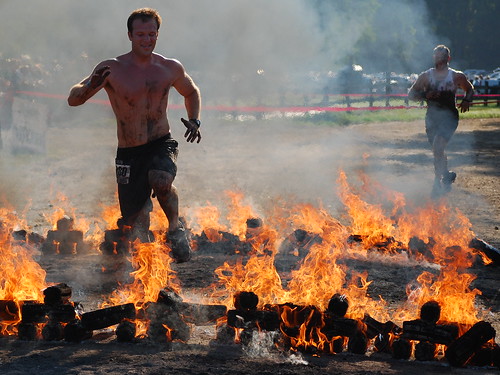
Warrior Dash Michigan

Here is the update on this blog:  
For a proper academic review of this subject see  Hunter and Eckstein 2009.
Exercise and osteoarthritis, two recent reports have been published with apparently conflicting conclusions:The medically orientated Nature Reviews in Rheumatology suggests there is (as I suggested in the previous blog optimal joint usage for healthy cartilage), and a sports medicine journal article from Dr Williams suggests that long distance running decreases risk of osteoarthritis.  
Naturally, from the Twittersphere, those people who love running feel their pursuit has been justified.  those people who commercial promote exercise will use it as propaganda.  I find it sad that on this issue, just like so many, people pick the evidence that suits their believes rather than balancing evidence.
Now lets start with a reminder.  Osteoarthritis is a condition of painful joints, which involves the whole joint, but one of its hall marks is the loss of cartilage.  Cartilage lines the hip and knee joints.  The cells that make it (chondrocytes) actually sit within the the cartilage of the joint.  They respond to the loads placed upon the joint by producing cartilage... within reason.  If you don't use a knee and hip joint at all, you would expect the muscles to waste away, the bones to become thin and brittle, and the cartilage become thin also.  I think we can probably all agree on this.  However, cartilage is a living tissue.  It is not shoe leather.  Part of the confusion is caused because cartilage has no blood vessels so it does not bleed, and it has no nerve fibers running out of it so you don't feel pain from the cartilage itself.  But it still needs to be loved!  We know for absolute certainty that excessive weight (high BMI) promotes you getting osteoarthritis, even the Dr William's paper shows this.
There is clearly debate as to how much usage is ideal.  The sporty paper could be used to support the argument that "it's the more the merrier", but there are huge confounding variables.  The author did what he could, but it is difficult!!! The analysis was not able to exclude two possibilities (1) That slimmer people (with lower BMI) may run more and (2) That people could start to run less when they get painful joints. If you believe that either (1) or (2) could be true they presumably you will come to the conclusion that this new paper does not really answer the key question of how much usage is ideal.
So the other paper, the Nature review?  Well it is just a few line summary of a very thorough paper in the "Osteoarthritis and Cartilage" journal.  But This is what is reported.  The LEAST active elderly people loose cartilage, but so do the MOST active!!!  Activity is assessed with a PASE survey, and yes age and BMI is taken into account.  Also, the study tracks people and so ceasing activity due to joint pain is less of a factor.  Now bare in mind this is activity assessed by PASE not running marathons!  PASE asks a number of activity questions, see Table 1. They then considered the top 15% and bottom 15% activity rates and compared against the middling people.
...BUT and here is the elephant in the room.  The health crises we have at the moment is due to obesity and lack of exercise of people, not over exercise, so whilst I would suggest that the jury is out on how much exercise is good for your joints.... for the rest of you LOTS of exercise is clearly a great thing.  ...and for me too, but I am lazy :-/

 So the conclusion:  Everything in moderation? 


Table 1: PASE Activities, Performances and Weight Scores
PASE stands for: Physical Activity Scale for the Elderly
ActivityAnswer  points
Walking and bicyclingHour/day     20
Light SRAHour/day     21
Moderate SRAHour/day     23
Heavy SRAHour/day     23
Muscle strength/enduranceHour/day     30
Paid/unpaid workYes/no     21
Light houseworkYes/no     25
Heavy houseworkYes/no     25
Home repairsYes/no     30
Lawn workYes/no     36
GardeningYes/no     20
Caring for othersYes/no     35


Exercise and Obesity

Now this one is more me!
Now I have to say I think the BBC "People men made us thin" series has been great, and in many ways music to my ears.  
The dogma are:
(1) Eating too much makes you fat.
(2) Exercise makes you thin.
(3) Genes

Do diets make you thin?
(1) They have gone some way to debunk this in the program.  Of course they have taken an extreme attitude.  If you don't eat, you will loose weight, but the psychology of dieting is more complex.  The study designs are difficult too.  So they studies showing diets don't work will usually say "here's a dieter 2 years later and they have put on 10lbs/5Kg, but here is a non-dieter and this person put on zero weight: ergo, dieting doesn't work".
There is a fundamental flaw in this argument though.  The people who diet typically have weight control issues and were always going to put on more weight than people who have never had a problem and never diet!!
So my bottom line would be that dieting is in no way all that it is cracked up to be, but if you are over-weight it is better to try and reduce your calorie intake than to just give up!!

(2) Does exercise make you thin

Again the program takes an extremist view of this issue.  I it is true that exercise is a really slow and relatively ineffective way of loosing weight  ...but it depends on the exercise, and whether it was the only lifestyle change you made.  Really this is a life-style thing.  To simply drive to the gym 3 times a week and burn off a few hundred calories is not going to make a significant contribution to a serious weight problem.  Those few hundred calories could easily be swallowed up just by one post exercise trip to Starbucks.  If you control calories and do more exercise, the exercise will prolong your life and keep you healthier, but really its the calorie-control bit that will knock off the pounds. Turn down that free chocolate bar at the checkout and you have just saved the equivalent of about a two mile run!  

(3) Genes
Your genes profoundly affect your weight.  This is mostly by changing the appetite control systems in your body.  Potentially there are many drugs which could change this, but it's not a great idea just yet, because these drugs tend to do too much other stuff.  ..i.e., "side effects".

All this lot is just the same for your pets too.  It's really important to give a dog a great walk or two every day... but weighing their dinners are the secret of weight control!!


Monday, 11 March 2013

Antibiotic Resistance