Twitter

Instagram View Richard Barrett-Jolley's profile on LinkedIn
Showing posts with label Osteoarthritis. Show all posts

Sunday, 4 December 2016

Biased Reviews of Products Online

Now here's the thing, there is some scientific literature offering support to the use of joint supplements, but in my opinion the jury is very much out.  Therefore most people base their choice, use it/don't use it, on anecdotal reports on the very websites that sell it.  Now when we Googled Yumove, we found that the reviews almost universally positive. So are they unbiased? Well Ozzie was a little unwell after using Yumove and whilst we clearly did not state it was due to the product, we thought it would be useful to other customers for us to upload the following review.  Sadly it was rejected due to "not meeting the guidelines".  This is an important lesson reminding us all that product reviews online are totally biased!
So here is the full review that Fetch rejected (typos and all!):
Dog not so well after using, so stopped it.
Well we saw rarve reviews of this, and bought for our older dog with quite poor hips. Clearly, it's asking a lot, but we are always hopeful. now we certainly don't know whether the Yumove caused the problem, but it happened straight away afterwards so we stopped. Basically this is what happene, out boy suddenly (within a day) became incredibly lethargic, stopped barking at postmen, stopped playing games etc. The lymph glands in his face (Buccal?) swelled bilaterally. The swelling wa large enough to see by eye, let alone palpate. The swelling suggests infection or allergy. Since the product has chondroitin, GAGS, HA etc, apparently from green lipped muscles allergy seems possibly. In people, or course chondroitin or shellfish allergy is well known, but I had never heard of it in dogs before. We stopped after about 5 days and you'll be pleased to know he was better within 2 days. Who knows if that was a coincidence or not, but we are frightened to use it anymore.

Sunday, 17 November 2013

King Richard III's spine and the "ion channels", "TRPV4".

Richard III skeleton
Funky ion channels in King Richard III's skeleton
I am sure that most sensible scientists, medics and vets would appreciate that ion channels are *the* most important proteins in the body? …OK all proteins are important, but none are as exciting as ion channels, which sit in the membrane of every cell and can control their functions.  …but I think it is about time to bring the word “ion channel” to the attention of archaeologists and historians through the medium of… Richard III’s skeleton.
The official line from University of Leicester (if there can be an official line) is that Ricky 3 had an idiopathic adolescent onset scoliosis.  Now the “scoliosis” bit just means “bent spine”, the “adolescent onset” bit is obvious and “idiopathic” is a posh way of saying “unknown cause”.
Therefore he had a bent spine since adolescence of unknown cause.  He also apparently had osteoarthritis.  It seems likely that a funky ion channel was at fault.  I have in mind, a particular ion channels with a gene name “TRPV4”.  In lay terms, it allows calcium to enter cells in response to movement.  Now what evidence do I have… .  eeerm…. none! That’s the great thing about blogs BUT just check-out the similarity of spine curvature with the bones of King Richard III and this well-studied literature example of a TRPV4 “channelopathy” below.

Parastremmatic dysplasia patient, with an ion channel disease

Not proof, I agree… but perhaps the many fans of Richard III should now start wearing tee-shirts with a TRPV4 channel on them… I present this suggestion below.  Have fun!!! 


Friday, 27 September 2013

Cartilage gets squished when you stand

Reprinted from Coleman et al 2012, yes with permission. It cost me $20 just to use it!
You can see the cartilage of a healthy human joint outlined in yellow (from an MRI).

I recently came across a great little paper on knee joint thickness by Coleman et al. It confirms what we may have already known or guessed.... but it does it beautifully and in a highly quantified manner. The data is from humans, but I would expect that similar would be seen with doggies! Very sophisticated experimental techniques, and modelling with some lovely beautiful pictures (!) and well controlled data.
Read the paper here Coleman et al 2012
The paper shows that there is a physical squeezing and compressing of cartilage when you stand up.  This has all kinds of ramifications to scientists who work in the area (like us!!).
The difference in thickness is quite small between day and night, but certainly significant in the knees.
Snippets of the data are that men's cartilage is much much thicker than womens'... and of course, there is a significant correlation between cartilage strain and body mass index (BMI).
...So if you want nice thick knee cartilage; be a chap, spend the day in bed*... but don't eat too much!!!

*...but seriously: it is generally accepted that moderate exercise is good for healthy joints, but excessive weight is an absolute no no......

Other blogs pertaining to osteoarthritis and exercise:
What Gives People and Animals Arthritis
Is Running Good for Your Health
Exercise and osteoarthritis


Tuesday, 20 August 2013

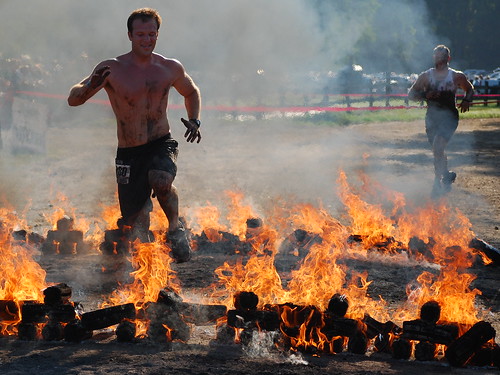
Is Running Good For Your Health?

Warrior Dash Michigan

Here is the update on this blog:  
For a proper academic review of this subject see  Hunter and Eckstein 2009.
Exercise and osteoarthritis, two recent reports have been published with apparently conflicting conclusions:The medically orientated Nature Reviews in Rheumatology suggests there is (as I suggested in the previous blog optimal joint usage for healthy cartilage), and a sports medicine journal article from Dr Williams suggests that long distance running decreases risk of osteoarthritis.  
Naturally, from the Twittersphere, those people who love running feel their pursuit has been justified.  those people who commercial promote exercise will use it as propaganda.  I find it sad that on this issue, just like so many, people pick the evidence that suits their believes rather than balancing evidence.
Now lets start with a reminder.  Osteoarthritis is a condition of painful joints, which involves the whole joint, but one of its hall marks is the loss of cartilage.  Cartilage lines the hip and knee joints.  The cells that make it (chondrocytes) actually sit within the the cartilage of the joint.  They respond to the loads placed upon the joint by producing cartilage... within reason.  If you don't use a knee and hip joint at all, you would expect the muscles to waste away, the bones to become thin and brittle, and the cartilage become thin also.  I think we can probably all agree on this.  However, cartilage is a living tissue.  It is not shoe leather.  Part of the confusion is caused because cartilage has no blood vessels so it does not bleed, and it has no nerve fibers running out of it so you don't feel pain from the cartilage itself.  But it still needs to be loved!  We know for absolute certainty that excessive weight (high BMI) promotes you getting osteoarthritis, even the Dr William's paper shows this.
There is clearly debate as to how much usage is ideal.  The sporty paper could be used to support the argument that "it's the more the merrier", but there are huge confounding variables.  The author did what he could, but it is difficult!!! The analysis was not able to exclude two possibilities (1) That slimmer people (with lower BMI) may run more and (2) That people could start to run less when they get painful joints. If you believe that either (1) or (2) could be true they presumably you will come to the conclusion that this new paper does not really answer the key question of how much usage is ideal.
So the other paper, the Nature review?  Well it is just a few line summary of a very thorough paper in the "Osteoarthritis and Cartilage" journal.  But This is what is reported.  The LEAST active elderly people loose cartilage, but so do the MOST active!!!  Activity is assessed with a PASE survey, and yes age and BMI is taken into account.  Also, the study tracks people and so ceasing activity due to joint pain is less of a factor.  Now bare in mind this is activity assessed by PASE not running marathons!  PASE asks a number of activity questions, see Table 1. They then considered the top 15% and bottom 15% activity rates and compared against the middling people.
...BUT and here is the elephant in the room.  The health crises we have at the moment is due to obesity and lack of exercise of people, not over exercise, so whilst I would suggest that the jury is out on how much exercise is good for your joints.... for the rest of you LOTS of exercise is clearly a great thing.  ...and for me too, but I am lazy :-/

 So the conclusion:  Everything in moderation? 


Table 1: PASE Activities, Performances and Weight Scores
PASE stands for: Physical Activity Scale for the Elderly
ActivityAnswer  points
Walking and bicyclingHour/day     20
Light SRAHour/day     21
Moderate SRAHour/day     23
Heavy SRAHour/day     23
Muscle strength/enduranceHour/day     30
Paid/unpaid workYes/no     21
Light houseworkYes/no     25
Heavy houseworkYes/no     25
Home repairsYes/no     30
Lawn workYes/no     36
GardeningYes/no     20
Caring for othersYes/no     35


Exercise and Obesity

Now this one is more me!
Now I have to say I think the BBC "People men made us thin" series has been great, and in many ways music to my ears.  
The dogma are:
(1) Eating too much makes you fat.
(2) Exercise makes you thin.
(3) Genes

Do diets make you thin?
(1) They have gone some way to debunk this in the program.  Of course they have taken an extreme attitude.  If you don't eat, you will loose weight, but the psychology of dieting is more complex.  The study designs are difficult too.  So they studies showing diets don't work will usually say "here's a dieter 2 years later and they have put on 10lbs/5Kg, but here is a non-dieter and this person put on zero weight: ergo, dieting doesn't work".
There is a fundamental flaw in this argument though.  The people who diet typically have weight control issues and were always going to put on more weight than people who have never had a problem and never diet!!
So my bottom line would be that dieting is in no way all that it is cracked up to be, but if you are over-weight it is better to try and reduce your calorie intake than to just give up!!

(2) Does exercise make you thin

Again the program takes an extremist view of this issue.  I it is true that exercise is a really slow and relatively ineffective way of loosing weight  ...but it depends on the exercise, and whether it was the only lifestyle change you made.  Really this is a life-style thing.  To simply drive to the gym 3 times a week and burn off a few hundred calories is not going to make a significant contribution to a serious weight problem.  Those few hundred calories could easily be swallowed up just by one post exercise trip to Starbucks.  If you control calories and do more exercise, the exercise will prolong your life and keep you healthier, but really its the calorie-control bit that will knock off the pounds. Turn down that free chocolate bar at the checkout and you have just saved the equivalent of about a two mile run!  

(3) Genes
Your genes profoundly affect your weight.  This is mostly by changing the appetite control systems in your body.  Potentially there are many drugs which could change this, but it's not a great idea just yet, because these drugs tend to do too much other stuff.  ..i.e., "side effects".

All this lot is just the same for your pets too.  It's really important to give a dog a great walk or two every day... but weighing their dinners are the secret of weight control!!


Wednesday, 24 April 2013

Exercise and Osteoarthritis

On the Run 
OK... Now we have a bit of a problem on the osteoarthritis and exercise front.
.........because exercise is good for joints, lack of exercise leads to obesity and is terrible for joints!
.....but its long been believed that traumatic injury (knocks and bangs!) leads to, or exacerbates osteoarthritis, but studies now show that, in rats a least, intensive exercise also contributes to osteoarthritis.  To be honest, a search of the major osteoarthritis journal Osteoarthritis and Cartilage will tell you that there are several similar studies, but this one attracted my attention; Carlos E.S. Franciozi et al 2013.  The tricky thing is that this implies that there is an optimal amount of exercise for you joint health.  How much is that?  Sadly, we just don't know :-(
It seems sensible to conclude that the amount required to stay fit, but no more!  That is bad news for MOST people, because most people either don't exercise at all or exercise massively!  ...me? Well I dog walk.  I don't think anyone has implicate that as hazardous for your joints yet!

Tuesday, 19 February 2013

What causes arthritis in people and animals/dogs

I am hoping to expand this section greatly, but for the time being lets keep this very simple:
In people there are two (common) very clearly distinguishable types of arthritis, rheumatoid arthritis and osteoarthiritis.  Hallmarks (according to a rheumatoid consultant colleague of mine) of rheumatoid are initial stiffness, whereas osteoarthritis tends to being with pain.  In dogs, arthritis is most commonly osteoarthritis, very similar to that seen in humans.  In all cases, there is some inflammation (so this includes swelling and stuff)... but rheumatoid is an autoimmune disease, where the body's own defence system attacks itself.

There are several treatments available, but the sad fact is none of them are terribly brilliant. Many will help a bit, prolong mobility and reduce pain, but there are no cures. 
Causes:  I think we would have to say rheumatoid is mostly genetic. Osteoarthritis is very clearly multifactorial.  There are several genetic factors which pre-disopose to osteoarthritis, but joint injury, excessive joint usage and obesity appear to be the cause in several cases.
What can you do about it?  The only thing we are reasonably confident of; is that keeping your own weight and the weight of your dog down.  Keep up regular exercise, but be aware that excessive force applied to joints could result in later development of osteoarthritis.